
Strategy Kills Creativity: The Great Brandland Debate
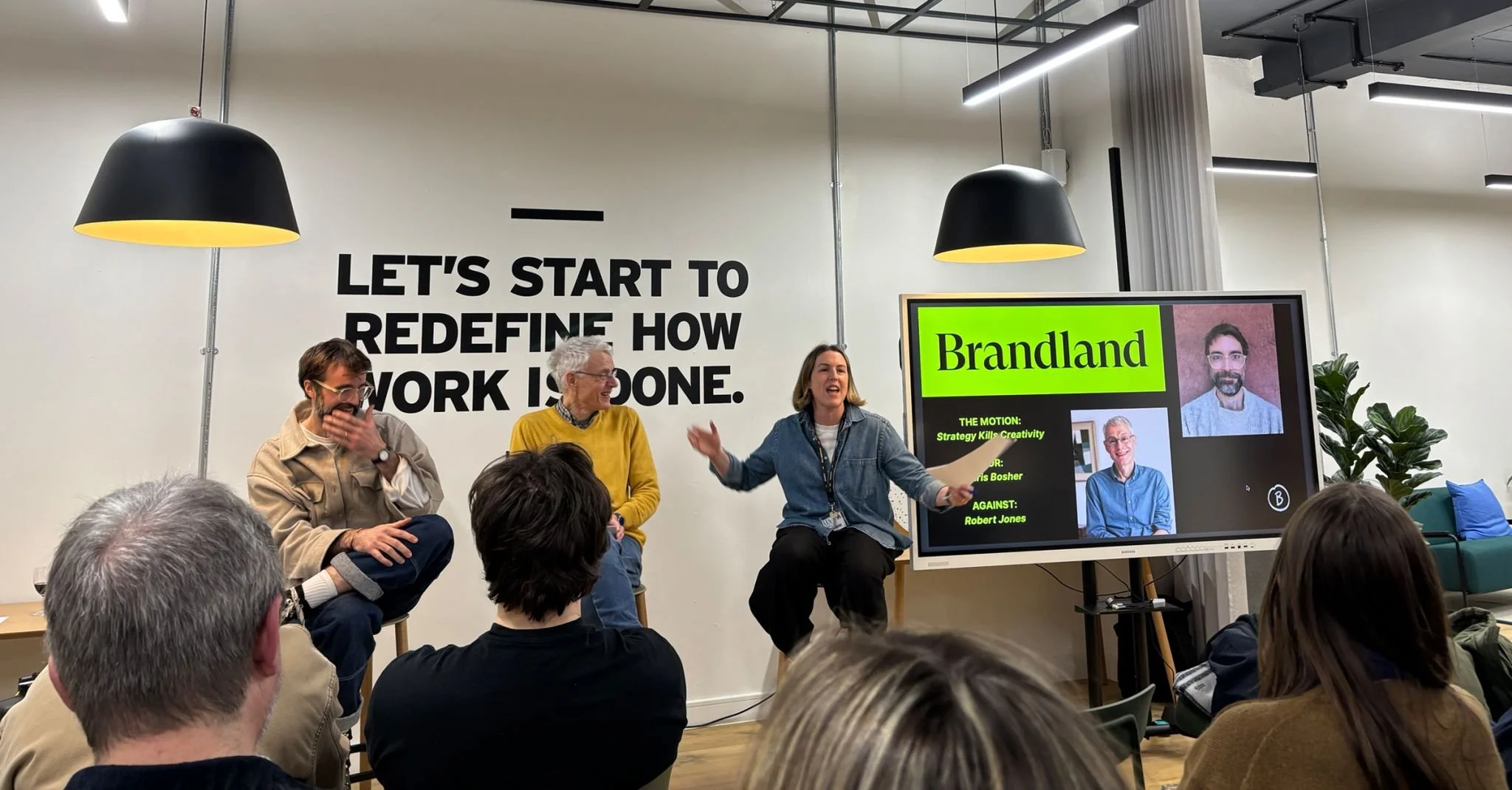
At the latest Brandland gathering, two heavyweights prepared to spar over one of the industry's most contentious questions: does strategy kill creativity?
Chris Bosher, a self-described "self-loathing strategist," argued for the motion. Robert Jones, brand consultant and former strategist at Wolff Olins, stood firmly against.
For the Motion: Chris Bosher
Chris wasn't interested in theoretical debates. He wanted to talk about practice - about how strategy and creativity actually play out in the real world. His argument rested on five observations:
1. Strategy Is Often Not Strategic
What passes for strategy is frequently just tactics. "Put the logo in the first five seconds. Introduce a system of fluent devices." These aren't strategic choices - they're micro-management dressed up as strategy. And they certainly don’t inspire creativity.
Worse still, strategy often delivers platitudes instead of insight, boring direction instead of galvanizing action, or elegant words that fail to grasp organizational reality.
2. Strategy Closes Doors It Has No Right To
Chris offered a devastating example from Guinness. Strategic guidance warned: "The extended pour time shouldn't be mentioned, as the dwell may well be a potential barrier to a younger demographic."
Had AMV/BBDO followed this in 1998, we wouldn't have Guinness Surfer - one of the most iconic ads in history, built entirely around the tension of waiting.
"Often a test of a good idea is that it is slightly terrifying in its lack of logic," Chris argued. "We must not conflate this with a lack of value."
3. We Over-Value Strategy
History is full of wonderful creativity that didn't have strategy near it. Paralympics' "Superhumans," Liquid Death, Nike's swoosh - "genius, no strategist or strategic process."
“The risk?” Chris said, “is that by over-valuing strategy we create the notion that if an idea is 'off brief' it must therefore be wrong, or at the very least lacks the rigorous underpinning of an idea that more clearly falls from the strategy - a rigidity that stifles originality”.
4. Strategy Worships Best-Practice
Strategy worships best-practice, obsessing over case studies, laws, principles, and retrospective analysis. We use 1980s TV case studies to dictate creative criteria for 2026. We apply principles from billion-dollar adspends to every shape of business without question, or let tech giants dictate strategy while never asking who profits.
“We ignore that brands exist within people, culture, and context—dynamic in ways beyond measurement, whose future cannot be understood by looking backwards. And strategy cannot claim to do anything other than kill originality if it obsesses over the pseudo-science of retrospect.”
5. Strategy Represents Logic Over Magic
In an era of low confidence and high risk, strategy has aligned itself with certainty, casting creativity as unruly and indulgent. But outside of existing scale, creative quality is the biggest driver of marketing effectiveness - a 12x multiplier on profitability.
The huge irony? In an uncertain world, risk is becoming imperative for success. Strategy that mitigates risk threatens the upside potential that stems from creativity.
Chris closed with Jamie Dimon's words: "I'd rather have first rate execution and second rate strategy, any time."
Against the Motion: Robert Jones
Robert's experience taught him something fundamental: a brand is what you stand for. Strategy is your ambition, your path, the choices you make.
"Strategy doesn't kill creativity," he argued. "It gives it life." He demonstrated through four mechanisms:
1. Strategy Sets Out Big, Exciting Ambitions
The National Trust's strategy to reach beyond country house lovers to families seeking open spaces inspired brilliant work that grew membership from 3 to 5 million.
2. Strategy Sets Out Realistic Constraints
When Oxfam's strategy said "don't change the symbol, but do become a global movement for change," it provoked Marina Willer to create a vibrant pattern system that transformed the brand while respecting its heritage.
3. Strategy Sets Out Resonant Meanings
Eat Real's strategy centered on "snackable food," which provoked a distinctive cookbook aesthetic that perfectly captured the brand's essence and achieved 23% growth in its first year.
4. Strategy Sets Out Outcomes
Chiswick Park's strategy led to the brilliant "Enjoy work" campaign - work that's still effective 25 years on.
"Strategy expands creativity through ambition, provokes creativity through constraints, briefs creativity through meaning, and guides creativity through outcomes," Robert concluded.
So Who Won?
When the room voted, Robert won the debate. But here's where it gets interesting: when we redrafted the motion to "Strategy hinders creativity," the room was far more evenly split.
That shift revealed everything. Both speakers are addressing the same industry from different vantage points.
Chris is railing against bad strategy - the kind that mistakes tactics for vision, closes doors prematurely, worships retrospection, and values certainty over creative courage.
Robert is celebrating good strategy - the kind that gives creative people clear purpose, productive constraints, resonant meaning, and measurable outcomes.
As Chris himself acknowledged: "In its theoretical definition, the idea that having a long-term vision necessarily hinders the act of invention is absurd."
The real insight from this debate was far more nuanced: bad strategy kills creativity, while good strategy gives it life. The question we should all be asking is - which kind are we practicing?
Thanks
A huge thank you to Spaces for hosting us, find out more about their brilliant working space here.